 |
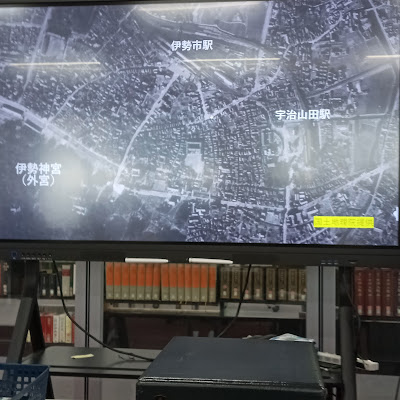
| Tourism created before-during-after WWII (bomb damage photo) |
Pilgrimage during the feudal years of Tokugawa times included elements of modern tourism (seeing sights, buying souvenirs, engaging in things out of the ordinary, dreaming of going, recounting after returning home), but the concept of "leisure" and the logistical possibility of recreational traveling as something named "tourism" (kanko, 観光) came closely associated with rail service around the country in the 1910s and later, including for school graduation excursions, for instance. Pr. H. brought illustrations, photos, words and music from a period wind-up record player for 78 rpm disks to bring all this to life from 100 years ago, along with picture postcards and 1-sen coins of the daily life 100 years ago.
Following on from the roots of tourism and the Jingu visits by people from near or far, Pr. S. presented the several varieties of rituals conducted annually and more infrequently at the Inner and the Outer Shrines of the Jingu. This set the stage for the bus ride 10 km to the northwest to the excavations of the last 50 years on the grounds of the Saiku (斎宮) where the Emperor's appointed female officiant (Sai-o) resided and would lead Inner Shrine rituals in June, October, and December. The first one began in 673 and the system continued until 1334 when the Kamakura leadership gave way to the Muromachi period. Besides a guided tour of the vast exhibits of the history museum there, our group also went to the nearby history experience center to put our minds and hands to work at making a woven amulet associated with the Heian period.
 |
| Layers in the museum: hologram at the Naiku, visitors reflected |
This photo showing both sides of the glass case is a good metaphor of the day: on the one hand we gain a glimpse of long-ago structures and people connected to the Ise Jingu, and on the other hand we who live in 2023 also are in the picture at the same time. The result is a sometimes confusing picture about what to focus on - things long ago or things today, things from the imperial Shinto responsibilities or things more directly experienced by ordinary people who live near the Jingu or visit for a day or two during their lifetime. The arena of images and interpretations is overstimulating and oversaturated thanks to digital access to huge amounts of information from more than one source. Since Shinto has many dimensions within society, within these traditions and practices, it is important to know something about all these parts. But it is also important to hold onto the central idea of kami and how each person engages with kami of a locale and for each context in one's lifetime.
There is a common denominator in all the forms of Shinto, whether at Ise Jingu, at one's neighborhood shrine, in front of a kamidana, or suddenly in the presence of a moment of natural awe in the wild. It is the inclination to uprightness (tadashii) with a sincere and pure heart (makoto; harai). No matter if it is the trained priests or lay persons, a person who pays respects at a big shrine or a small one, at a place with a visible shintai object of veneration or one that is hidden in a honden, in all cases the root motivation remains the same for young or old, man or woman, rich or poor, in sickness or in health.
 |
| Kogakkan high school graduation rehearsal 2/28 |
This photo of young people on the verge of finishing their schooling and going out into the world of higher education, vocational training, or directly into employment is the embodiment of the future. It is what carries Ise Jingu into the future and by extension also the shrines famous and those only known to local residents. This is how the kami and the people of these islands transmit the customs and underlying ideas to those yet to come.


Comments
Post a Comment