The mild day ended with bouts of sun breaking through the clouds to shine on the crowds of visitors both distant and ones closer to home. This video clip shows the sakaki sprigs that ring the no-camera, sacred interior of the place to pay one's respects to the kami, Toyouke. There is something wondrous about the flutter of the zigzag paper strips or the leaves of trees moving in the passing breeze. The subject of tradition comes to mind and the way each generation takes the baton with its own hands and with some influence of its own time. Researchers have shown that non-verbal rituals, in particular, can transmit forms well for many generations, but also that the definition of tradition involves one generation giving up control to the next one. So there is usually some small change along the way. Indeed, certain practices that people suppose existed "forever" have a birth date of their own; that is, the ritual or verbal art began in some moment. Question-1: for the roots of all the calendar of rituals performed at the Geku, above, when did each start (and why)?
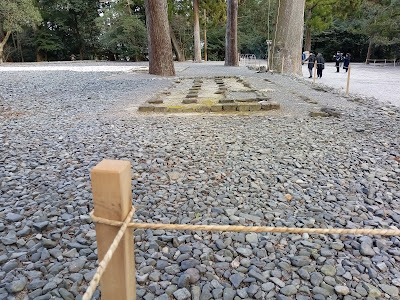 |
| adjacent to the 2023 Geku sacred precinct to renew in 2033 |
This photo shows the view at the exit to the currently functioning worship space of the Geku. In the cycle of rebuilding every generation (20-year intervals), the next one will be sited here. After the earlier one is dismantled and some elements are "downcycled" to other shrines and purposes, then the vacated site will be a mirror image of this view. However, following the novelist approach to near-future science-fiction, it is possible to imagine some terrible world event or natural disaster for dystopia: then if there is no rebuilding for many decades or centuries, the archaeologists will see only stone foundations like this one.
Question 2: if the organizational culture and institution of organized Shinto stopped in this example, would Shinto "in the wild" begin again, or transfer naturally among those living through the next generations? This question echoes the one that people ask about other cultures and religions, such as Christianity: ancient 'house churches' were different to the cathedral kind today, and Judaism after the Temple was destroyed in 70 CE also differed to today.
 |
| kayak near Isle of Skye, west coast of Scotland 2-2023 (Nick Ray) |
This screenshot from today's Twitter of the 365-day sea kayaker who is circling Scotland, Nick Ray, shows a waterfall putting freshwater into the sea's saltwater. Question 3: For a person in the habit of paying respects to kami in Japan, is the same principle of noticing and respecting the natural places the same, or different. In other words, could a Shinto priest, or an average Japanese (or indeed non-Japanese) seek out places such as this sea waterfall to pay respects in a way that equals the traditions practiced on Japanese land?
Question 4: At the risk of projecting human hierarchies onto sacred ones, when there are so many Shinto shrines in the country and also within the Jingu of Ise, how do the relative statuses function when humans pay their respects, and maybe equally well, when kami interact with kami or with creatures other than the two-legged hominin kind. This photo from Yoshio Inari Jinja in the Funae neighborhood of central Ise is dotted with shimenawa rope boundaries and small pillars with the kami name for the 700-year-old tree, for the large rock, for the small shrine, for the large shrine. All together at first look, maybe there are a dozen identified shintai (objects of veneration) that are highlighted, but maybe other ones are equally important, although do not have shimenawa or posts.
 |
| looking from east to the west at Yoshio Inari Jinja (Funae Jinja) |


Comments
Post a Comment